Giovanna overhears her father compare her to Vittoria
The Lying Life of AdultsGiovanna overhears her father compare her to Vittoria when she is twelve, and the remark turns a private fear about her changing body into a crisis of family identity. She hears not merely that she resembles her aunt, but that the beloved father whose assurances had anchored her sense of herself may see her as carrying the features of a woman her parents have taught her to fear. The comparison propels her toward Vittoria, whom she must meet in person if she is to understand what her father’s words mean.
The Overheard Comparison
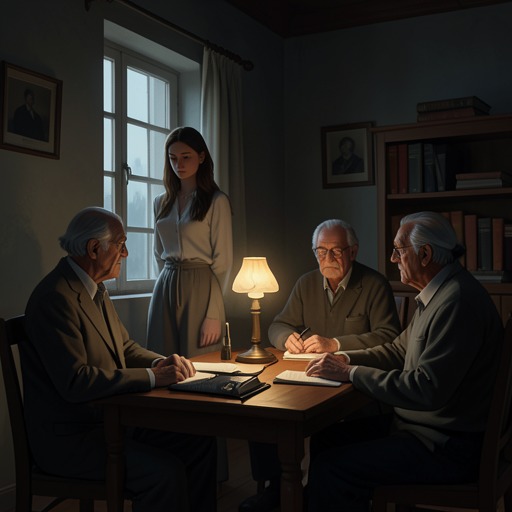
Giovanna has been studying until exhaustion, but her results remain disappointing. After her mother returns from speaking with the teachers, she reports that the mathematics teacher is especially dissatisfied but believes Giovanna can improve if she wants to. Her mother offers the changes of early adolescence as an explanation; when Giovanna’s father comes home, however, he rejects it. Speaking in a tone unlike the playful ease he normally uses with his daughter, and slipping into dialect in a household where it is forbidden, he says, “Adolescence has nothing to do with it: she’s getting the face of Vittoria.”
The exchange is accidental from Giovanna’s perspective. Her parents think her bedroom door is shut, as it usually is, but it has been left open. She hears her father’s voice muffled by his effort to speak quietly, and understands that at twelve she has learned from him that she is becoming like his sister. That sister, as far back as Giovanna can remember, has been associated in her father’s descriptions with ugliness and spite. The force of the remark comes from what it implies rather than from an explicit insult: her father does not call Giovanna ugly, but invokes a family name already made to stand for everything repellent.
A Face Made Frightening by Family
Before this moment, Giovanna has seen Vittoria only a few times and remembers little about her personally. What she remembers is her parents’ aversion and fear. Her father has spoken obscurely of his sister, as if she were involved in shameful practices that could defile those around her; her mother has avoided mentioning her and tried to silence her husband when he erupts. In the child’s imagination, Vittoria becomes a bogeyman: a lean, demonic figure who might charge up the long, steep San Giacomo dei Capri, bring the illnesses of neighborhood hospitals into the family home, smash the furniture, and strike her mother. These terrors belong to the parents’ reactions and the child’s interpretation of them, not to any remembered encounter in which Vittoria actually does those things.
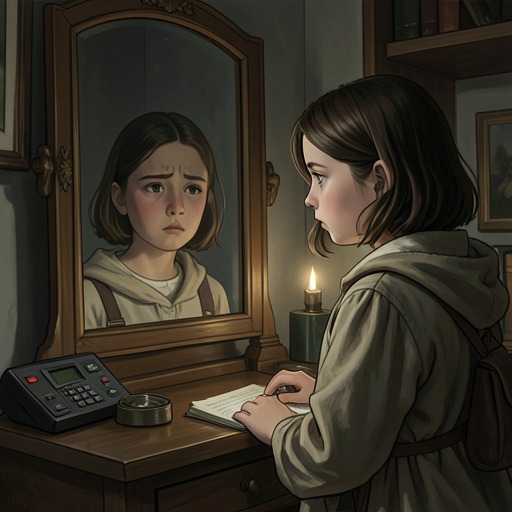
The comparison lands during a period when Giovanna feels especially vulnerable. She began menstruating nearly a year earlier, is embarrassed by her visible breasts, worries that she smells bad and washes constantly, and feels lethargic. Until then, her comfort and certainty have rested on the conviction that her father adores all of her. His remark therefore threatens more than her belief that she is pretty: it unsettles the love through which she has learned to believe she is lovable. She has thought her hair beautiful and assumed, encouraged by her father, that she would remain beautiful. Now she fears that an advancing ugliness, already visible to him, may be the source of her parents’ unhappiness with her.
Her mother does not repair the damage. Though she detests her husband’s relatives and dislikes Vittoria, she only weakly denies the resemblance; she does not forcefully tell him that his daughter and sister have nothing in common. Giovanna retreats behind her bedroom door and weeps in silence. At dinner she joins her parents with dry eyes, looks down at her plate while they offer advice about her grades, and returns afterward to pretending to study. Her immediate distress persists through the night, compounded by uncertainty about whether her father spoke from momentary irritation or from a judgment he had long held.
From the Upper City to the Family’s Hidden Ground
By morning, Giovanna has settled on a response: if she is to save herself, she must find out what Vittoria’s face is really like. The decision sends her into a part of family life from which her father has largely withdrawn. Her mother’s relatives have a clear address and a familiar place in Giovanna’s childhood; her father’s relatives seem to belong to an unnamed world below. The family visits them rarely, usually for weddings or funerals, and those encounters are marked by strained politeness. Her parents become tense beforehand and seem, afterward, to forget the visits by mutual consent.
That division is mapped onto Naples itself. Giovanna’s familiar city is the high ground of the Vomero, with streets leading toward Villa Floridiana, where she spent time with Angela and Ida. Farther down lie the routes her parents take for work, shopping, study, and debate; beyond those recognizable names, the lower city becomes increasingly unknown to her. Going to her father’s relatives means descending so far that she imagines reaching another city altogether. Her parents’ anxiety on those journeys gives this geography the quality of a family secret: the relatives are not simply distant but belong to a place the child has been taught not to know.
On the Sunday journey to see Vittoria, Giovanna’s father finally speaks about his origins. He says that he was born and grew up in the neighborhood, and that his family was poor. He then stops at a more dilapidated building and identifies it as the place where he lived and where Vittoria still lives. The visit makes the resemblance question concrete. Giovanna climbs uneven, broken stairs to a door marked with the surname Trada; after ringing twice, she hears Vittoria’s hoarse dialect from inside and confronts the aunt herself rather than the frightening outline made from her parents’ stories.
The Aunt’s Counter-Story
Vittoria does not confirm the simple verdict implied by her brother’s comparison. In a later exchange, she criticizes Giovanna’s pink shoes, jacket, and barrette, and tells her that she is not growing up well. She also accuses her of believing lies more readily than truth. Her words offer no reassuring, neutral account of the family. Instead, they begin another contest over how Giovanna should look, what she should believe, and which adult’s judgment deserves her attention.
Vittoria takes Giovanna to meet the father’s other siblings and calls the excursion a chance to meet her blood. On those visits Giovanna discovers that she has barely known, or perhaps never learned the names of, these relatives. Vittoria reproaches her father for depriving his daughter of their affection and urges Giovanna to look at the difference between her family’s worlds. Her repeated command to look challenges the sheltered perspective created by her parents’ silence. The relatives live in small, plainly furnished apartments that Giovanna has been taught to regard as crude or vulgar, yet they welcome her warmly and do not make her responsible for their hostility toward her father.
They call her Giannina, a name her parents have never used. Among them she feels unusually open, relaxed, and funny; she even imagines that the name has brought out a different person from the Giovanna known at home and at school. Her response complicates the original comparison. Family resemblance is no longer only a feared physical inheritance transmitted through Vittoria’s face: it is also a question of belonging, language, and the self that emerges in a different family setting. The overheard remark begins as a wound inflicted by a father’s judgment, but it sends Giovanna into a wider and less settled inquiry into who gets to describe her, and what those descriptions conceal.